Woodland Trust Objection
The Woodland Trust is the UK’s leading woodland conservation charity. We own over 1,000 sites across the UK, covering over 30,000 hectares (ha). In Scotland we own and care for around 60 sites covering in excess of 11,300ha which include the 4,000ha Glen Finglas estate and significant urban forestry holdings in Glenrothes and Livingston.
We are an evidence-led organisation, using existing policy and our conservation and planning expertise to assess the impacts of development on ancient woodland and ancient and veteran trees. Planning responses submitted by the Trust are based on a review of the information provided as part of the planning application.
Woodland Trust Position
The Trust objects to this application due to loss and deterioration of the ecological condition of ancient woodland designated on NatureScot’s Ancient Woodland Inventory (AWI). We are specifically concerned about: –
- Direct loss of 1.27 hectares of ancient woodland (ASNO 1a plus unmapped) as a result of the Lower Control Works.
- Direct loss of 0.03 hectares of ancient woodland (ASNO 1a) from access track works.
- Direct loss of 4.83 hectares of ancient woodland specified as ‘AWI’ from pre-construction and enabling works.
- Direct loss of 1.97 hectares of woodland specified as ‘LEPO’ – the extent to which this is also on the NWSS and hence likely to be of greater ecological value is unclear.
- Potential loss of veteran trees, particularly within the woodland on the shores of Loch Ness.
- Deterioration of the ecological condition of ancient woodland from construction and operational use of adjacent infrastructure.
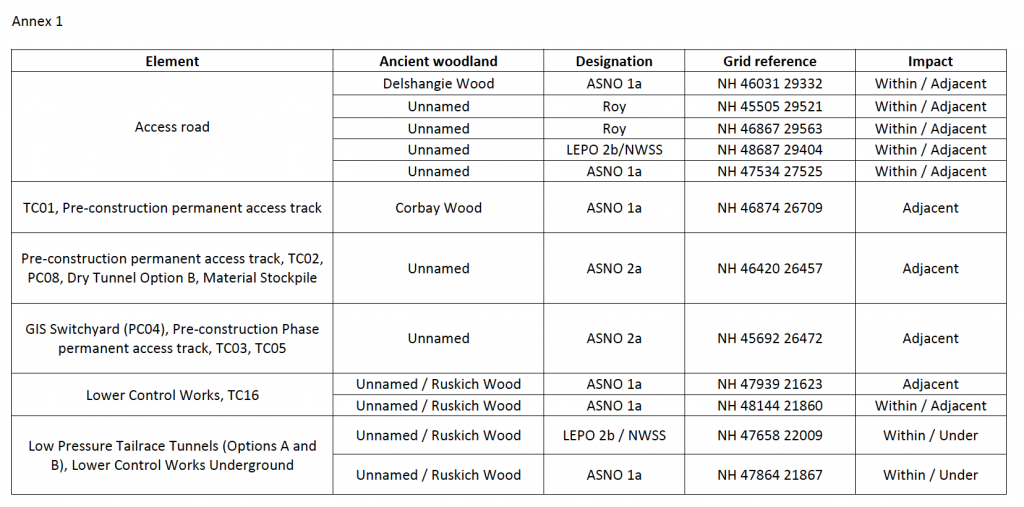
We have provided details of ancient woodlands impacted by the proposals in Annex 1.
Ancient Woodland
NatureScot’s Ancient Woodland Inventory (Ref 1) has three main categories of woodland, all of which are of value for their biodiversity and cultural value by virtue of their antiquity:
- Ancient Woodland (1a or 2a) – Interpreted as semi-natural woodland from maps of 1750 (1a) or 1860 (2a) and continuously wooded to the present day. If planted with non-native species during the 20th century they are referred to as Plantations on Ancient Woodland Sites (PAWS).
- Long Established of Plantation Origin (1b or 2b) – Interpreted as plantation from maps of 1750 (1b) or 1860 (2b) and continuously wooded since. Many of these sites have developed semi-natural characteristics, especially the oldest ones, which may be as rich as Ancient Woodland.
- Other woodlands on ‘Roy’ woodland sites (3) – Shown as unwooded on the 1st edition maps but as woodland on the Roy maps. Such sites have had, at most, only a short break in continuity of woodland cover and may still retain features of Ancient Woodland.
These types of woodland, particularly Ancient Semi Natural Woodlands, include our most important and biodiverse terrestrial habitats. They are scarce, finite and irreplaceable, and therefore must be protected.
LEPO woodland
As detailed within the AWI, LEPO woodland can develop important characteristics and be considered as rich as ancient woodland. Where LEPO woodland sites are also recorded on the Native Woodland Survey of Scotland, as detailed in Annex 1 below, it is likely that such sites will have a majority native canopy cover and should therefore be protected in line with national planning policy.
National Planning Policy
The Scottish Government has declared that biodiversity decline is as important as the climate emergency. With ancient woodland being one of our most biodiverse habitats, we must protect and enhance this, especially at this time when we know that according to the State of Nature 2019 report, one in nine species in Scotland is at risk of extinction. Climate change is impacting our biodiversity, and developments such as this are putting additional strain on already fragmented habitats which contain much of Scotland’s remaining biodiversity. While we acknowledge that this development is intended to further the UK’s climate change mitigation goals, it must go hand in hand with protecting biodiversity and nature.
Scottish Government adopted the National Planning Framework 4 (NPF4) on 13th February 2023. Policy 6 (Forestry, woodland and trees) states the following: –
“b) Development proposals will not be supported where they will result in:
- Any loss of ancient woodlands, ancient and veteran trees, or adverse impact on their ecological condition;
- Adverse impacts on native woodlands, hedgerows and individual trees of high biodiversity value, or identified for protection in the Forestry and Woodland Strategy;
- Fragmenting or severing woodland habitats, unless appropriate mitigation measures are identified and implemented in line with the mitigation hierarchy;
“c) Development proposals involving woodland removal will only be supported where they will achieve significant and clearly defined additional public benefits in accordance with relevant Scottish Government policy on woodland removal. Where woodland is removed, compensatory planting will most likely be expected to be delivered.”
The Control of Woodland Removal Policy (CoWRP) states: “There will be a strong presumption against removing the following types of woodland: ancient semi-natural woodland; woodlands listed as ‘Plantations on Ancient Woodland Sites’ (PAWS). There will also be a strong presumption against woodland removal where it would lead to fragmentation or disconnection of important forest habitat networks.”
This application is contrary to NPF4 Para (b) (i) and CoWRP, and it fails to meet the criteria of NPF4 Para (c). Given the strong presumption against ancient woodland removal in the CoWRP, the applicant needs to demonstrate that significant public benefits outweigh the loss of irreplaceable habitat arising from the development. It has not been demonstrated that there are “significant and clearly defined additional public benefits” arising from this particular energy scheme. The discussion of ‘need’ in the Planning Statement is high level and does not assess the need for this PSH scheme at this location. Furthermore, we do not consider the extent of loss of irreplaceable habitat has been definitively quantified. We therefore consider that compliance with NPF4 Para (c) has not been demonstrated.
It is not appropriate to consider compensation measures until it has been established that the proposal complies with NPF4 Policy 6 and the CoWRP.
Impact on Ancient Woodland
- The development will result in the following significant impacts: –
- Direct loss of ancient woodland for the Lower Control Works.
- Direct loss and damage to ancient woodland trees, soils and understorey from access track related felling and core path realignment.
- Damage to the ecological condition of ancient woodland from construction and intensified use of widened access tracks.
- Disturbance to sensitive fauna from vibration, noise and light pollution arising from drilling, blasting and construction of tailrace tunnels and underground works.
- Potential indirect impacts associated with the construction and operation of various infrastructure works in the Glen Coiltie area.
Loss of Ancient Woodland – Quantification
The terminology used in the various reports makes it difficult to fully understand the precise extent of ancient woodland loss resulting from the proposal as a whole. Terms such as Ancient Woodland; Semi-Natural Woodland; Native Broadleaved Woodland; Native Broadleaved Woodland (AWI); Native Woodland are used, with no consistent referencing to NatureScot designations on the AWI (for example, ASNO 1a, LEPO 2b, Roy etc).
Loss of Ancient Woodland – Lower Control Works
The Planning Statement confirms the loss of 1.27 hectares of ancient woodland (ASNO 1a plus unmapped ancient woodland) associated with the Lower Control Works.
Loss and deterioration of Ancient Woodland – Access Track
With regards to woodland at Glen Urquhart, it is stated that sections of the woodland are designated as ASNO 1a and 2a, and LEPO 2b. It should be noted that there are also Roy designations which do not appear to have been identified in the report. These are listed in Annex 1.
Appendix 18.2 states that “due to extensive historical commercial forestry operations, there are no remnant features present that would typically characterise ancient woodland. The long-term impact of commercial planting has significantly altered the original woodland structure and composition.”
We would advise that the irreplaceable nature of ancient woodland is bound to its soils, and that a woodland in poor condition can be improved with careful management. NatureScot should be consulted in cases where woodland designated on the AWI is considered no longer ancient due to commercial activity. We are pleased to note confirmation that discussions with NatureScot will be undertaken to determine their view on the classification and ecological value of the various parcels of ancient woodland. Until these discussions are completed it is not possible to fully understand the extent of loss of ancient woodland.
Felling of trees and clearance of scrub are required for “selective widening” of the access track. It is stated that 0.03 ha of ASNO 1a would be removed. We have not been able to find details of the specific designations of the 4.83 ha of ancient woodland specified as ‘AWI’, or detailed figures for loss of LEPO/NWSS woodland or Roy woodland arising from works to the access track.
Impacts from Tunnelling
Potential impacts in relation to tunnelling works include root encroachment, disturbance of ancient woodland soils, vibration, noise, light and dust pollution.
We note from Chapter 10: Water Environment that wet and dry tunnels will for the most part be constructed at considerable depth. However, we would appreciate confirmation as to the depths of tunnels beneath areas of ancient woodland, and beneath buffer zones to ancient woodland.
With regards to the noise and vibration assessment, we note the focus is on human receptors not ecological receptors. There is some assessment of lighting with regards to ecological receptors. The oCEMP states: “Where lighting is necessary, appropriate low glare lighting will be used to minimise the impact of lighting on ecological receptors, including nocturnal species. Any artificial lighting required for construction works would be directional to avoid or minimise light spill beyond immediate works areas and would be turned off when not required.” However, it has not been demonstrated that tunnelling can be carried out over 24-hour periods in close proximity and under ancient woodland without impacting nocturnal species.
Glen Coiltie works area
Proposed works include permanent and temporary construction compounds, tunnel portal, material stockpiles and the switchyard. The potential for impact is outlined in Annex 1. It is stated in the Landscape and Ecology Management Plan that the works have been designed to avoid “direct impact” on ancient woodland. However, we have not been able to find an assessment of how root encroachment of ancient woodland boundary trees and other indirect impacts will be mitigated, including the feasibility of providing appropriate buffer zones given the constraints associated with the various parcels of ancient woodland in this area.
Impact on Ancient and Veteran Trees
An ancient tree is one that has passed beyond maturity into an ancient life stage or is old in comparison with other trees of the same species.2 They can be individual trees or groups of trees within woodlands, wood pastures, historic parkland, hedgerows, orchards, parks or other areas. Attributes can include their great age, size, condition, biodiversity value as a result of significant wood decay and the habitat created from the ageing process, together with their cultural and heritage value. Ancient trees are therefore exceptionally valuable and irreplaceable habitats.
A veteran is a mature tree that has developed valuable decaying wood features, not necessarily as a consequence of time, but due to its life or environment. Veteran trees may not be very old, but share similarities with ancient trees, such as trunk or branch hollowing, or significant amounts of other decaying wood.3 Veteran trees can be individual trees or groups of trees within woodlands, wood pastures, historic parkland, hedgerows, orchards, parks or other areas. They are irreplaceable habitats.
The impact on ancient and veteran trees arising from this development does not appear to have been assessed and we have been unable to find a tree survey.
We note that Appendix 18.1: Woodland Report – Loch Ness states that the woodland contains large veteran trees, including sessile oak and downy birch. It is not clear whether these veteran trees would be felled as a result of the proposed felling of ASNO 1a in connection with the Lower Control Works.
It is essential that ancient and veteran trees are protected from loss or deterioration resulting from the development. It is therefore important that an arboricultural impact assessment is undertaken to ensure that ancient and veteran trees are identified, protected from felling, and provided suitable buffer zones to ensure there are no indirect impacts arising from adjacent construction or operation.
Conclusion
Ancient woodland and veteran trees are irreplaceable habitats. Any loss or deterioration of the ecological condition of these habitats arising from this development needs to be avoided through design changes and implementation of appropriate mitigation measures. If this is not possible then the application should be refused.
The Woodland Trust objects to these proposals due to the significant loss of ancient woodland and deterioration of the ecological condition of irreplaceable habitat.
References
1 https://www.nature.scot/doc/guide-understanding-scottish-ancient-woodland-inventory-awi